

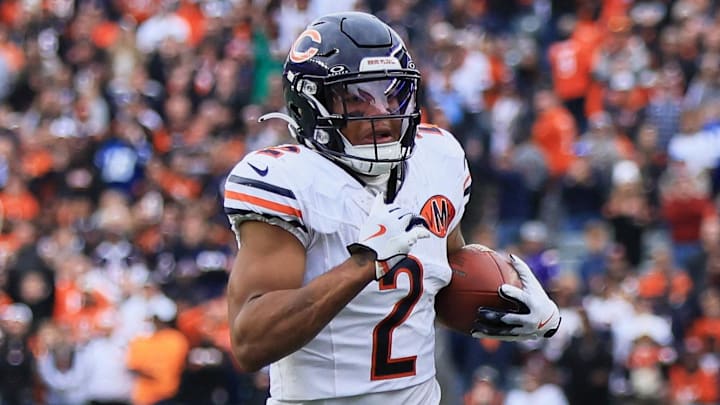
The Buffalo Bills have their new wide receiver in soon-to-be 29-year-old D.J. Moore, who spent the past three seasons as the Chicago Bears’ top receiver. General manager Brandon Beane parted with a second-round pick and received a fifth-rounder in return to execute the deal.
Of course, the trade isn’t official until the new league year flips on March 11th, and it can’t go through until the Bills are cap compliant, meaning Beane will need to get to work on finalizing some restructures at the top of the roster payroll.
In the meantime, all any of us can do is talk about the trade, and make a call on whether or not it was a good decision for the Bills as they reload for the 2026 season. It is talking season, after all.
Early evaluation of Bills’ D.J. Moore trade highlights key concerns
NFL.com’s Kevin Patra has been grading the offseason trades across the league as they come through, and like many, he wasn’t as impressed by the trade for Buffalo as he was for Chicago. He graded the move as a B- for the Bills, but an A- for the Bears.
For the Bears, this trade, coupled with the sudden retirement of 27-year-old center Drew Dalman and the release of linebacker Tremaine Edmunds, opens up roughly $44 million in cap space, giving them a real shot at making a move for a superstar player like Maxx Crosby.
But for the Bills, there isn’t so much certainty in the move. Moore’s production gradually declined over the past three seasons, as he caught just 50 passes for 682 yards (both career lows) and six scores during the 2025 regular season. He did catch fire in his first postseason appearance in January, but not so much as to alleviate the concerns around his production.
Still, Bills Mafia holds out hope that head coach Joe Brady can revitalize Moore’s career. After all, Brady coached Moore during two of the receiver’s strongest seasons in Carolina in 2020 and 2021.
But the trade's draft cost for Buffalo is what seemed to stick out most to Patra.
“The pick swap will drop Buffalo about a hundred draft slots, from Round 2 to Round 5. In a draft that's viewed as meatiest in the second and third rounds, the Bills are essentially moving from grabbing a potential starter on a cost-controlled contract to rolling the dice on a possible rotational player. On a team that needs low-cost contributors, that's significant,” he wrote on Thursday.
Thankfully, Patra never used the word, but many fans outside of Buffalo think the Bills were 'fleeced' by giving up a second-round pick for Moore, considering his contract and production. The added news that Philadelphia reportedly rejected the New England Patriots with an offer of a first and third-round pick for A.J. Brown doesn’t help matters, as it insinuates Buffalo had to settle for Moore after being priced out on Brown. Still, that’s speculative, and it’s not as though the Bills can’t continue to address the position, as they well should.
There are still suitable options in free agency who can boost the receiver room, such as Tampa Bay Buccaneers veteran Mike Evans. The team also still has enough draft capital to target a mid-round receiver to flesh out the depth, too. Buffalo certainly isn’t in a position where Moore is the only addition they can afford to make, even if their finances are a bit strapped overall.
Nonetheless, fleeced isn’t an accurate descriptor of a trade that earns a B- grade. Until we see Moore’s production on the field, it’s an intriguing move that will be better suited for a final grade later. That said, for it to turn out as a passing grade, Buffalo can’t assume Moore is the answer to all the problems out wide. Whether in free agency or the draft, the Bills would do well to target another receiver to add to the group.
 Add us as a preferred source on Google