

The Buffalo Bills have addressed the wide receiver position by trading for Chicago Bears veteran wideout D.J. Moore. In doing so, general manager Brandon Beane parted with a 2026second-round draft pick, and got a fifth-rounder in return.
Naturally, the move completely changes the trajectory of the Bills’ draft plans. While the team could certainly still target a young receiver in the draft, having Moore in the building at the very least takes away the pressure to target the position in the first round.
Nonetheless, without that second-round pick, Beane will have to be even more precise with his limited selections. Let’s take a look at how he could handle the first four rounds of the draft now that he has just three picks.
How Bills GM Brandon Beane could navigate Buffalo’s draft with limited early-round picks
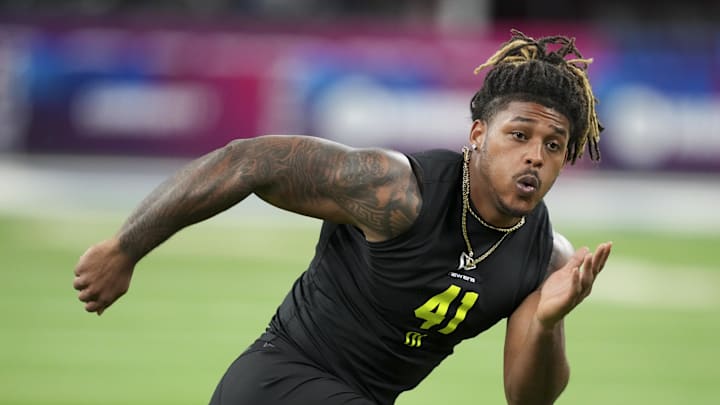
With wide receiver addressed, the Bills' first-round options appear rather clear: take an impactful defender, or trade back and recoup the lost picks in the Moore trade. I wouldn’t discount a trade, but if Texas A&M star Cashius Howell falls to 26, the Bills have a serious decision to make.
At the NFL Combine, Howell’s arm measurement raised a significant red flag on his scouting report. His 30¼” arms are the shortest of any player drafted in the past 20 years. That could impact his stock, pushing him out of the middle of the first round as he had been projected leading up to the Combine.
Howell’s arm length is a legitimate concern, but Jim Leonhard has experience working with short-arm pass rushers, and Howell’s production in the SEC, where he recorded 15.5 of his 27 career sacks, proved to some degree that he can overcome his limitations. He’d be the speed freak opposite the powerful Greg Rousseau, and potentially serve as the cornerstone pass rusher this team desperately needs.
Barring a trade back, the Bills have a long wait for their second pick in the draft. Understandably, defense is still a priority at pick No. 91, and that’s where the Bills could find an interior run-stuffer who fits into Leonhard’s scheme with Iowa State’s Domonique Orange.
Orange is an intriguing prospect because he gets great penetration into the backfield and his measurables suggest he should be a stronger pass rusher than his single collegiate sack would indicate. Still, Buffalo’s main priority on the defensive front is finding scheme fits who can offer meaningful depth.
Orange wouldn’t be asked to rush the passer often in Year 1, instead helping to further the cause of improving the run defense, which finished 28th in the NFL last season in that regard. From there, he can develop and potentially morph into an interior powerhouse in the middle of Buffalo’s defense.
If Buffalo sticks with their current batch of picks, then Round 4 is as good a time as any to begin to fill some gaps on the offensive side. With center Connor McGovern expressing that he thinks his time in Buffalo is over, and Beane likely lacking the funds to even entertain bringing David Edwards back, the Bills could use some developmental depth on the interior offensive line.
Beau Stephens isn’t the most decorated member of the group of Hawkeye blockers in this class, but his value stacks up in the fourth round as a beefy run blocker. Stephens has position flexibility across the three interior spots, and while it’s best if he’s not on the field as a rookie, he’s a solid backup plan if Alec Anderson or Sedric Van Pran-Granger don’t work out as replacements for Edwards and McGovern, respectively.
 Add us as a preferred source on Google