

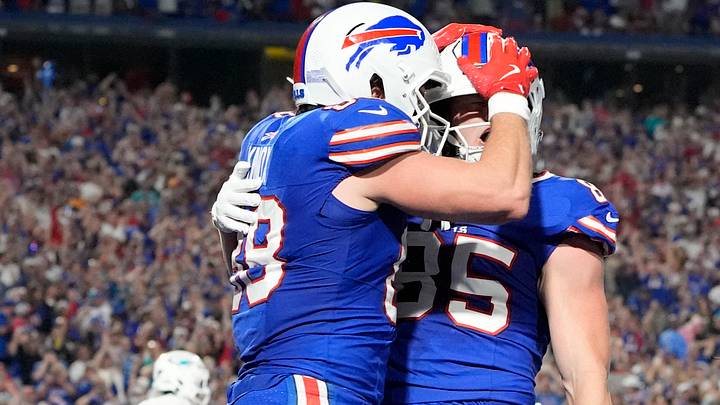
In today's NFL, many teams, including the Buffalo Bills, are going as deep as four to five tight ends on the field at the same time. Back in the day, tight ends were traditionally used to block for the running back, helping him gain those extra yards.
Sometimes, teams are lining up in a five-tight end package because they are replacing them with a traditional fullback who is lining up in front of the running back and blocking in the run game. For example, the NY Jets, led by head coach Aaron Glenn, positioned no running back in the backfield, with five tight ends being used on the line last week when facing the Green Bay Packers.
While Dalton Kincaid has been lighting it up as a receiving tight end, fellow tight ends Dawson Knox and Jackson Hawes have been showing their talents by blocking effectively, which has been helping out running back James Cook and the team's run game.
Let's take a look at how this tight end tandem has been performing as a 1-2 punch this season.
Dawson Knox and Jackson Hawes bringing their A-game
Dawson Knox has been giving it his all since being drafted by the Bills in the third round of the 2019 NFL Draft. After going through multiple contract renegotiations, he is one of the few homegrown draft picks to still be playing his entire career in Orchard Park.
After posting 36 receptions for 417 yards last season, Knox has only 3 receptions for 12 yards so far in this young season. He is focusing more on blocking alongside teammate Jackson Hawes. While he is known for his receiving skills too, he should be using his 6-foot-4, 253-pound frame better as a blocking tight end.
After leading the way for Cook, who last year was named the NFL rushing champ for running for 1,621 yards, Knox has already been helping the speedy running back on the ground this year as he currently totals 192 yards.
Of course, if it wasn't for Knox blocking and helping out his teammate, Hawes wouldn't be the tight end he is today with the Buffalo Bills.
Hawes is arguably the founding father of today's usage of multiple tight ends rather than having a fullback, because he is skilled at blocking in two-or three-tight-end sets or lining up as an H-back, which doesn't require a fullback.
Because of his early success in 2025, the 2026 NFL Draft saw an increase in blocking and H-back tight ends being drafted as early as the second round. He is also improving at catching the rock; as last year, he totaled 16 receptions for 187 yards.
Protecting team's No. 1 QB
While Knox and Hawes are still run-blocking for Cook, this is forcing defenses to have extra defenders creep up into the lanes. It allows tighter man-to-man coverage, with all the wideouts being covered.
This allows Josh Allen to run for big yards and pick up those first downs on third-and-long.
Knox and Hawes are also being used as extra protection for Allen by chipping edge rushers, which then allows Allen to run to the outside and gain a great deal of yardage when he's scrambling.
Without Kincaid's presence as a receiving tight end, both Knox and Hawes wouldn't be the blocking tight ends they are today. All three tight ends bring a special talent to the team and provide their unique versatility.
 Add us as a preferred source on Google