

As a consistent contender, the Buffalo Bills often face challenges of the salary cap variety. It becomes tougher to make impactful trades or to make big splash moves that fan bases love so much. Part of that can be mitigated by skillful drafting, but only a few teams manage to do that with any real consistency.
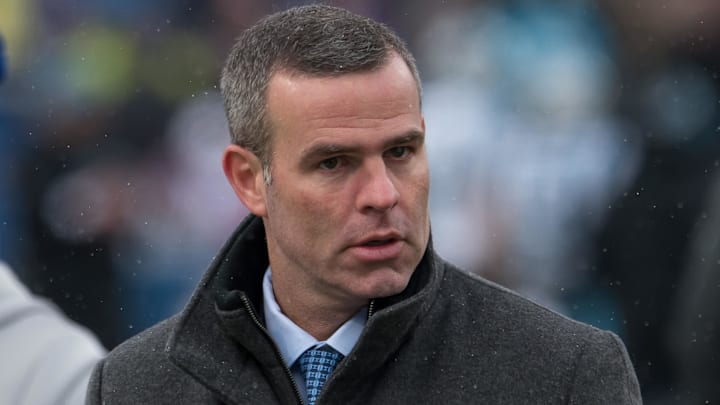
That said, the best general managers know how to work with the salary cap to make it work for them. General Manager Brandon Beane will have to do his best to give the Bills enough flexibility to keep their contention window open with Josh Allen at quarterback.
Despite the cap rising by around $23 million from 2025, Beane will be working with some additional limitations, namely $29 million in dead cap space for the 2026 season. That said, there are a few logical moves that can help the Bills gain enough room to find upgrades at several positions.
The Cap Situation: An Overview
Sources are projecting the NFL’s salary cap to be $305.7 million, which would leave the Bills at roughly $10.2 million over the cap. That puts them at 7th from the bottom in cap space. It really isn’t that bad, especially when you consider another contending team – the Kansas City Chiefs – is a whopping $58 million over.
Step 1: Restructures
The clearest move for Beane is to restructure the contract of his superstar quarterback. Allen is set to count for $56.3 million against the cap, but restructuring frees up $12.1 million in space. The other no-brainer restructure is tackle Spencer Brown. Adding a void year would free up $4.7 million in cap space.
There are two others that will at least be considered for restructured deals. The first is Dion Dawkins. Still an elite tackle, Dawkins will be 32 years old when the season begins. He has two years left on his deal and his $24.8 million cap hit is second-highest on the team. Adding a void year to his deal is risky but frees up $11.3 million.
The other restructure candidate is DT Ed Oliver. His fit in new defensive coordinator Jim Leonhard’s scheme is up for some debate. If Beane sees a fit for him, adding a third year to his deal would mean $10.2 million in savings for 2026. Assuming the four of them are restructured, that would equate to $38.3 million in cap savings.
Step 2: Salary Cuts
Dawson Knox is perhaps the most hotly discussed name within Bills circles. He provides value to the team and is a solid tight end, not to mention the fact that he’s Allen’s best friend. That said, his $17.8 million cap hit is simply not an option.
The most realistic option is an extension that is effectively a pay cut. It would reduce his cap hit to something more team-friendly – ideally in the $8-$10 million range – which could free up quite a bit of money. Let’s say the extension puts him at $10 million per year, which equates to $7.8 million in cap savings.
Taron Johnson is the other candidate for a pay cut. Like Oliver, his place in the new defense is unknown. Releasing him is an option but comes with nearly $7 million in dead money in 2027. Johnson could stay with an extension and a pay cut from his $11.4 million cap hit. Extending and restructuring him to an additional year at $6 million would result in $4.2 million in savings.
Step 3: Letting Free Agents Walk
The first option is backup quarterback Mitch Trubisky. He’s fine for what he is but his $4.4 million salary is high, especially given the fact that Allen does not miss time save for garbage starts in the final week of the season. If he wants to come back, fine, but it has to be for a steep reduction in salary.
The two names that matter most are offensive linemen Connor McGovern and David Edwards. Protecting Allen is vital and both are key to one of the best offensive lines in the league. The reality is that they may be too expensive to keep around.
McGovern is a more realistic option but will likely command in the neighborhood of $15 million per season, if not more. Edwards, meanwhile, has been projected to net $15-$18 million per season. Given the other priorities the Bills have, keeping both feels unlikely.
The Bills do have options even if both walk. Sedrick Van Pran-Granger, Alec Anderson, and a value free agent could compete for the two spots without a major fall-off. The cap savings in the short-term would also be substantial.
Step 4: Cuts
There are a slew of players here who could fit the bill. The most obvious is receiver Curtis Samuel. Releasing him will save $6 million toward the cap and free up another spot in the receiver room.
The Bills will also likely give a good, long look at cutting safety Taylor Rapp and kicker Tyler Bass. Cutting Rapp would save $3 million pre-June 1 but it might make sense to hang onto him and see what they can do between the draft and free agency. You could always cut him post-June 1.
At $4.9 million against the cap, Bass is entirely too expensive to keep given his performance. That said, Beane said he expects Bass back. The Bills could look at him through OTAs and put him in competition with an undrafted free agent kicker or just cut him post-June 1 to save $3.9 million.
The Final Tally
Let’s assume that the Bills make every move on this list. That would leave them with $63.2 million in savings and $53.2 million in cap space to work with. That should be enough to make solid moves on the offensive line, invest in the safety position, and make a splash at edge or receiver.
Many of these decisions come with consequences down the line, but if the Bills haven’t won a title in three years, there are bigger things to worry about than the cap situation. The move should be to clear up as much space as possible to make a big impact and push to win now with Allen in his prime.
 Add us as a preferred source on Google